In precision manicure, similarity in appearance often conceals fundamental mechanical differences. While skin scissors and nail scissors may seem closely related, they are engineered for entirely distinct cutting environments. The nail plate presents a dense, compact keratin surface that requires controlled structural strength. Cuticle tissue, by contrast, is soft, elastic, and far more responsive to pressure.
For this reason, the two instruments cannot share identical construction. The decisive factor lies in scissor blade geometry — the cutting angle, blade thickness, curvature, and tip refinement that determine how force is transferred during trimming. In German-made grooming tools influenced by Solingen craftsmanship, geometry is never standardized across functions. It is purpose-built to match the material it is designed to cut.
Material Resistance Determines Blade Architecture
Nails require controlled force to separate. The blade must be strong enough to cut through a compact keratin structure without flexing. For this reason, nail scissors are typically manufactured with slightly thicker blades and a cutting edge designed to withstand firmer resistance.
Skin, by contrast, demands delicacy. Cuticle tissue is thin and elastic. Excess pressure can cause pulling rather than cutting. If the blade geometry is too thick or the edge angle too wide, the tissue compresses before separation — increasing the risk of irregular trimming.
This is why professional skin care tools are engineered with:
Finer blade profiles
Narrower cutting angles
Ultra-precise tips
Reduced structural bulk near the edge
In precision grooming scissors, geometry adapts to biology.
The Critical Role of Scissor Blade Geometry
Blade geometry governs how force is transferred. In nail scissors, the edge angle is optimized for durability. The cutting motion must remain stable under moderate resistance. Slight curvature supports shaping the natural nail contour while maintaining structural strength.
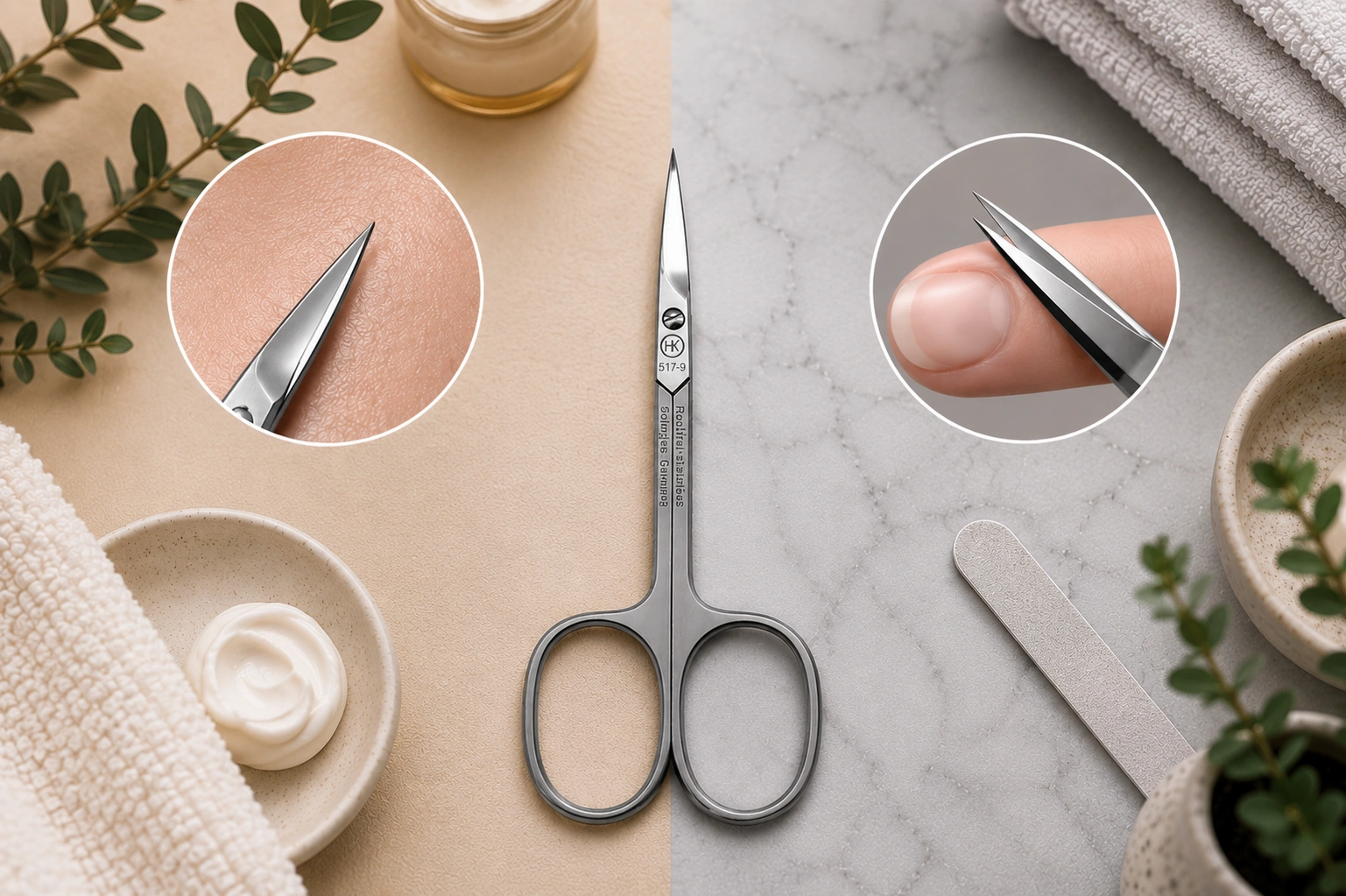
In skin scissors, the geometry shifts toward refinement. The blade is slimmer, the tip more tapered, and the cutting angle sharper. This configuration enables accurate removal of fine cuticle fragments without disturbing surrounding tissue.
The difference is not cosmetic. It is mechanical.
Even minor variations in blade thickness or tip shape influence:
Cutting precision
Tissue control
Safety margins
Long-term edge retention
In professional manicure tools, these details separate functional instruments from precision-engineered ones.
Why Nail Scissors Should Not Be Used on Skin
Using nail scissors for cuticle trimming often leads to pulling or incomplete cuts. The thicker blade geometry may prevent the cutting edges from meeting delicately enough for soft tissue. As a result, excess pressure is applied.
This compromises precision and may create uneven edges. In professional environments, such inconsistency is unacceptable.
Conversely, using skin scissors on nails can strain the fine blade profile. The thinner edge is optimized for minimal resistance, not for repeated cutting through dense keratin.
Each instrument performs optimally within its intended mechanical environment. This specialization reflects the engineering standards found in German precision tools.
Curvature, Tip Design, and Micro-Control
One of the most significant differences between skin and nail scissors lies in the tip. Skin scissors feature an extremely fine, narrow tip that allows targeted trimming close to the cuticle line. This precision reduces unnecessary contact with adjacent skin.
Nail scissors, while often curved, are constructed to follow the arc of the nail plate. Their tip geometry prioritizes shaping accuracy over micro-fragment removal.
In Solingen craftsmanship tradition, curvature is calibrated to ensure that blade alignment remains consistent along the entire cutting path. Stainless steel selection further stabilizes this alignment, preventing deformation at the pivot and preserving cutting consistency.
Precision grooming scissors must feel intuitive in hand. That tactile balance originates in geometry.
Engineering Application in Professional Skin Scissors
At Hans Kniebes, the development of professional skin care tools begins with tissue analysis. Blade thickness, edge refinement, and pivot calibration are coordinated to ensure smooth, controlled cutting.
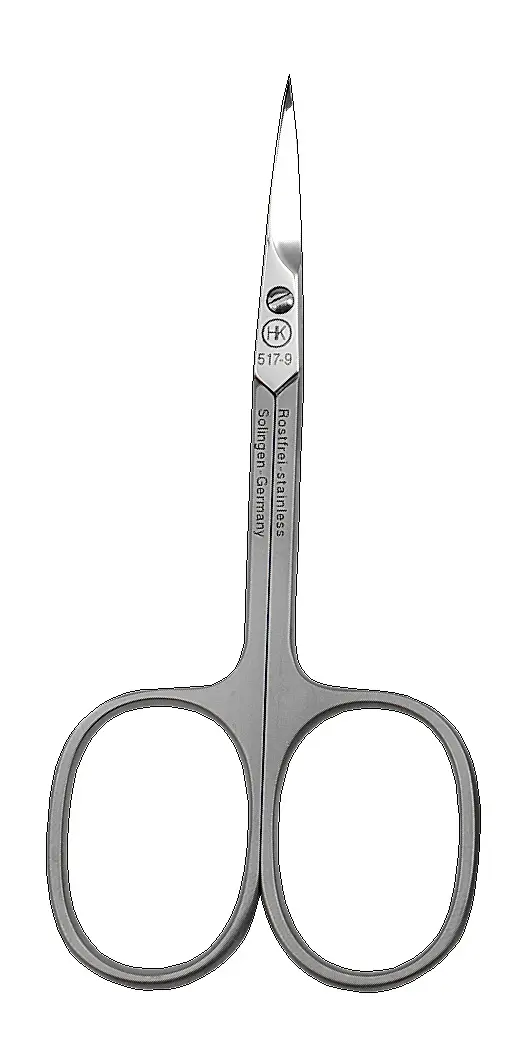
An example of this principle can be seen in our curved stainless steel skin scissors, crafted from high-grade stainless steel with ultra-fine blade geometry and a precisely adjusted screw system, the 90 mm curved design enables accurate cuticle trimming while maintaining fluid, resistance-free movement. The refined tip structure supports controlled detailing without excessive pressure on delicate skin.
Here, geometry is not aesthetic. It is functional precision.
The Broader Principle of Purpose-Built Grooming Tools
Professional grooming scissors are not universal instruments. Each is developed to interact with specific material properties. The density of the nail plate and the elasticity of cuticle tissue demand different structural solutions.
In German-made manicure instruments, this specialization reflects an engineering mindset: the right blade for the right task.
At Hans Kniebes, we do not design tools for general use. We engineer instruments for defined performance outcomes. Skin scissors and nail scissors may share visual similarities, but their scissor blade geometry reveals distinct mechanical identities.
Precision is achieved not by compromise, but by differentiation.
FAQs
1. What is the difference between skin scissors and nail scissors?
Skin scissors have finer blade geometry and sharper tips for delicate cuticle trimming, while nail scissors are thicker for cutting dense nail plates.
2. Why can’t nail scissors be used for cuticle trimming?
Nail scissors are designed for harder keratin surfaces and may compress or pull soft cuticle tissue instead of cutting it cleanly.
3. What makes professional skin scissors more precise?
Professional skin care tools feature ultra-fine tips, narrow cutting angles, and precise blade alignment for controlled trimming.
4. Why is scissor blade geometry important in manicure tools?
Scissor blade geometry determines how force is applied, affecting precision, safety, and long-term edge retention.
5. Are German-made skin scissors better for professional use?
German-made grooming tools, especially those influenced by Solingen craftsmanship, are engineered for precision, durability, and reliable performance.
Related products